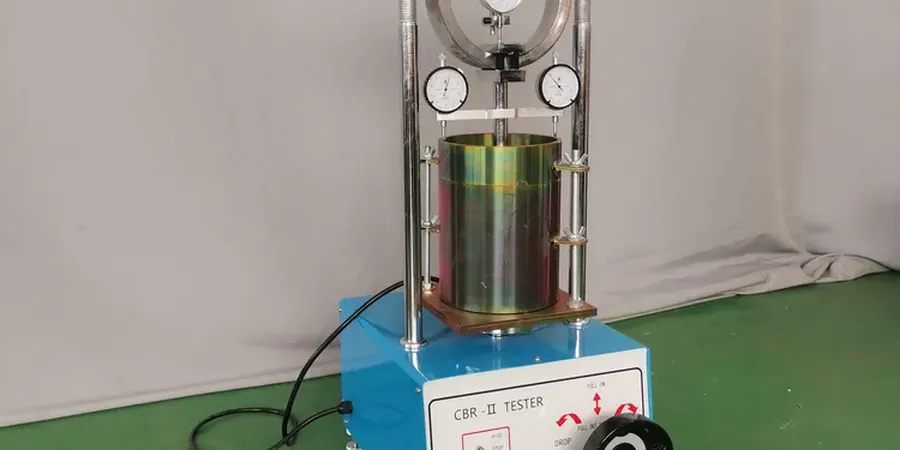
A recent industrial subdivision off Manukau Road required a complete re-evaluation of the subgrade after heavy rain exposed the sensitivity of the local Pukekohe volcanic ash. The contractor had placed fill to level, but the soaked bearing strength dropped below 3%, triggering a design review. In Pukekohe, the [Laboratory CBR test](#) becomes essential because the volcanic-derived soils across the Franklin district change dramatically between dry summer conditions and winter saturation. Our team runs compacted specimens at optimum moisture content and then soaks them for 96 hours to simulate the worst field conditions a pavement will ever see. Whether for a dairy tanker turnaround in Patumahoe or a collector road through a new greenfield subdivision near Pukekohe East, getting the soaked CBR right determines the entire pavement thickness design. We prepare specimens using standard Proctor effort or modified Proctor when the project traffic loading demands it, always referencing the specific NZS 4402 test methods that TNZ and local council engineers expect to see in the geotechnical report.
A soaked CBR difference of just 2% can mean an extra 150 mm of granular fill across an entire subdivision—getting the number right in the lab saves real money on site.
Methodology and scope
NZS 4402:1986 governs the testing sequence we apply in Pukekohe, specifically Test 6.1 for the California Bearing Ratio determination. The volcanic ash deposits across Pukekohe—often classified as MH or ML silts with halloysite content—exhibit moisture sensitivity that standard compaction alone cannot capture. We run the test in three key stages: compaction at the target moisture-density range, a 96-hour soak under a 4.5 kg surcharge weight to replicate overburden and capillary rise, and penetration at 1.27 mm per minute using a calibrated load ring. The load-penetration curve tells us immediately whether the material will punch-shear under traffic or maintain adequate stiffness. For granular subbase materials sourced from local Pukekohe quarries, we also run unsoaked CBR to check compliance with TNZ M/4 specifications, which often require soaked CBR values above 15% for heavy-duty pavements. The laboratory CBR test data feeds directly into the mechanistic-empirical pavement design charts, reducing the risk of over-designing the granular layers or under-estimating the required cover over the subgrade.
Frequently asked questions
What is the typical turnaround time for a laboratory CBR test in Pukekohe?
The full test cycle takes approximately 7 working days. This includes specimen compaction at the target moisture content, the mandatory 96-hour soaking period under surcharge load, and the penetration test with subsequent load-penetration curve analysis and reporting. We can sometimes expedite the reporting phase for urgent pavement design queries, but the 4-day soak cannot be shortened without compromising the result's validity for Pukekohe volcanic ash conditions.
How much does a laboratory CBR test cost in Pukekohe?
A single-point CBR test (one specimen, soaked) typically costs between NZ$180 and NZ$340, depending on whether the specimen is compacted at standard or modified Proctor effort and whether swell measurements are required. A full three-point CBR series for pavement design purposes falls at the upper end of that range per specimen. The price includes specimen preparation, the 96-hour soak, penetration testing, and a signed test report with the load-penetration curves. We recommend obtaining a written quotation for your specific material type and project requirements.
Why does Pukekohe volcanic ash need a 96-hour soak for the CBR test?
The volcanic ash soils around Pukekohe contain halloysite and allophane clay minerals. These minerals have a tubular or spherical microstructure that traps water slowly, meaning saturation is not instantaneous. A 24-hour soak typically reaches only 60-70% of full saturation, producing an artificially high CBR value. The 96-hour soak specified in NZS 4402 Test 6.1 ensures the specimen reaches equilibrium moisture content, which is what the subgrade will experience in service during a wet Pukekohe winter. Shortening the soak period has led directly to under-designed pavements in the Franklin area.
What CBR value should I expect for a typical Pukekohe subgrade?
For undisturbed Pukekohe volcanic ash at natural moisture content, field-equivalent soaked CBR values generally range between 3% and 8%. Compacted fill placed at 95% of maximum dry density and near optimum moisture content can achieve soaked CBR values of 5% to 12%, depending on the specific ash horizon and the compactive effort applied. Values above 15% are uncommon for untreated volcanic soils in the Pukekohe area. If the pavement design requires a subgrade CBR higher than 12%, lime or cement stabilisation is usually the next step to investigate.