A truck-mounted CPT rig is the first piece of equipment we mobilize for liquefaction assessment in Pukekohe. The cone pushes through the young alluvial and volcanic soils that characterize the Franklin district, measuring tip resistance and sleeve friction at 2 cm intervals. Pore pressure transducers behind the cone capture excess pore water generation in real time. For sites where CPT refusal is expected, we deploy an automatic SPT hammer system with calibrated energy ratios. The split-spoon sampler recovers disturbed samples from each test depth, which we log in the field using the NZGS field description guidelines. Thin-walled Shelby tubes then extract undisturbed specimens from critical layers, typically at depths between 3 and 12 meters where loose pumiceous sands and silts are common. These specimens are transported to the laboratory under temperature-controlled conditions for cyclic triaxial testing, which measures the number of uniform stress cycles required to trigger liquefaction. The entire field program is designed to capture the stratigraphic complexity of the Pukekohe basin without disturbing the sensitive volcanic ash layers that control pore pressure dissipation.
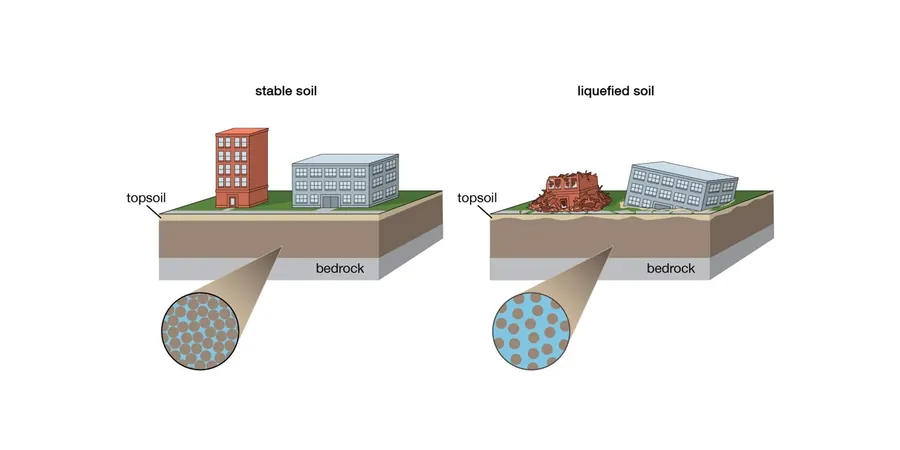
Liquefaction in the Pukekohe basin is controlled by the depth to groundwater and the abundance of loose pumiceous sands, not just peak ground acceleration.
Local considerations
In Pukekohe, we frequently observe that contractors underestimate the lateral spreading potential along the shallow drainage channels that cross the town. The topography appears flat, so the assumption is that ground deformation will be uniform. The reality is different. Even a 0.5% gradient across a 30-meter site can produce enough lateral displacement to shear pile foundations if a liquefiable layer is present at depth. Another persistent issue involves pumiceous soils. These volcanic-derived particles have internal voids that produce misleading SPT blow counts; the sand appears denser than it actually is. A correction based on particle crushing strength is necessary, otherwise the factor of safety against liquefaction is overestimated. The NZGS guidelines explicitly address this for the Taupo Volcanic Zone derived soils present in Franklin. Finally, post-liquefaction reconsolidation settlement is often calculated only for free-field conditions, ignoring the additional settlement caused by structural loads bearing on softened ground. The combined effect can exceed serviceability limit states within the first 25 mm of differential movement for rigid structures.
Frequently asked questions
How is the depth to groundwater determined for a Pukekohe liquefaction assessment?
We install standpipe piezometers in boreholes drilled to at least 2 meters below the deepest suspected liquefiable layer. Readings are taken over a minimum of seven days to allow for equilibration in the silty soils common around Pukekohe. The highest seasonal water level is used in the analysis, not the level measured on the day of drilling, per NZGS Module 4 recommendations.
What is the cost range for a complete liquefaction study in Pukekohe?
A complete liquefaction assessment in Pukekohe, including CPT soundings, borehole drilling, laboratory cyclic triaxial testing, and an engineering report with settlement and lateral spreading analysis, typically ranges between NZ$3,840 and NZ$6,580 depending on the number of test locations and the stratigraphic complexity of the site.
Does the volcanic ash layer found under Pukekohe liquefy?
The weathered tephra layers common in the Pukekohe profile generally exhibit clay-like behavior with plasticity indices above 15%, which places them outside the liquefiable range per the Chinese criteria adopted by NZGS. However, interbedded pumiceous silts within the ash sequence can develop excess pore pressure. We test these materials specifically using cyclic triaxial equipment rather than relying on SPT or CPT correlations calibrated for hard-grained sands.
How do you account for the effect of pumice particles on SPT N-values?
Pumiceous sands crush under hammer impact, absorbing energy that would otherwise advance the sampler. This produces N-values that are lower than those of equivalent-density hard-grained sands. We apply the Orense et al. (2012) pumice correction factor, which scales the measured N-value based on the particle crushing strength index. This corrected value is then used in the Boulanger and Idriss triggering spreadsheet.