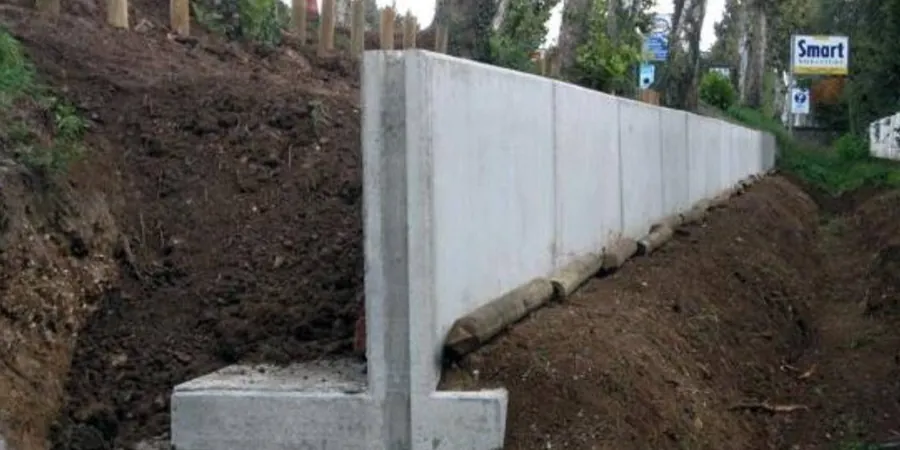
In Pukekohe, many homeowners and builders discover the hard way that a generic concrete panel wall won't handle the local ground. The volcanic ash soils here, derived from the weathered Bombay Basalt, hold moisture differently across a single section. You might have stiff, structured clay near the surface and a looser, silty layer just two metres down. Our team has been involved in enough Franklin district retaining projects to know that the design must account for this layered drainage behaviour. Combining our retaining wall assessments with in-situ permeability testing gives us the true pore-water pressure profile, and when we need to confirm the bearing capacity of a residual soil layer, we use our CPT equipment to get a continuous resistance profile before finalizing the footing geometry.
In Franklin's volcanic terrain, ignoring pore pressure behind a wall is the single most common cause we see of long-term tilt and failure.
Local considerations
Pukekohe sits at an elevation of roughly 60 metres on rolling basalt country, and with a population approaching 28,000, infill housing is common. Cutting into a slope for a new build creates a surcharge condition that older boundary fences were never designed to handle. The risk isn't just a cracked footing. A failed retaining wall in Pukekohe's ash soils often triggers a progressive slump, pulling the garden and even part of the driveway with it. The cohesion of the volcanic soil drops sharply when saturated, so a poorly drained wall becomes a liability during our heavy winter rain events. We see this pattern repeatedly in older subdivisions. Our designs address this by specifying subsoil drains at the heel, weep holes through the stem, and a capillary break layer, ensuring the wall performs for decades regardless of the season.
Frequently asked questions
Do I need building consent for a retaining wall in Pukekohe?
Under the Building Act, any retaining wall supporting a surcharge (like a driveway or building) or exceeding 1.5 metres in height requires a building consent from the Auckland Council. Our design package includes the producer statements (PS1 for design) that the council will request.
What is the typical cost range for a retaining wall design in Pukekohe?
For a standalone design on a standard residential section in Pukekohe, the engineering fee typically ranges from NZ$1,920 to NZ$7,500 depending on wall height and complexity. A 1.2-metre timber pole wall design is at the lower end, while a 3-metre reinforced concrete cantilever with site-specific geotechnical investigation sits at the upper end.
How deep do the footings need to be for a retaining wall on volcanic ash?
The depth is governed by the bearing capacity of the ash and the sliding resistance required. In Pukekohe, we typically see footing embedment of at least 400 mm into competent, undisturbed soil. However, if the wall is on a slope or near the basalt interface, we often need a deeper key to resist sliding during a seismic event.