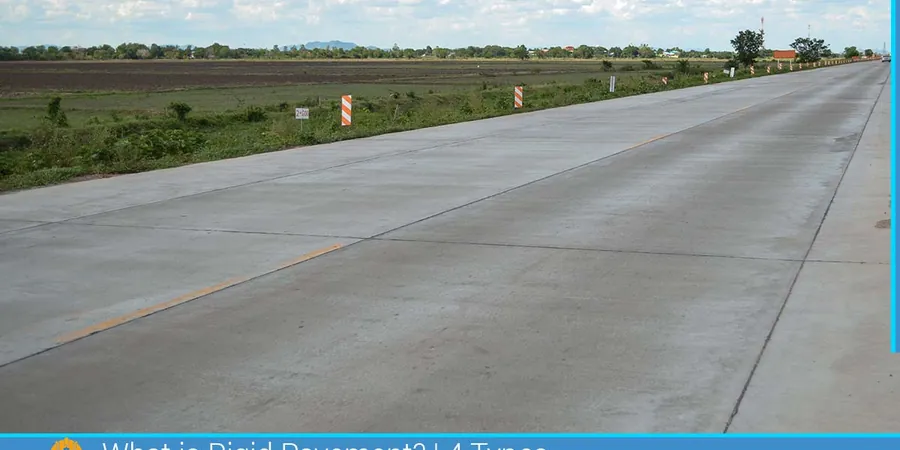
Pukekohe sits at 60 meters above sea level, right on the edge of the South Auckland volcanic field, where basalt lava flows dictate what contractors can build without cracking. The area's 27,000 residents and the massive horticultural logistics network demand pavements that survive forklifts, heavy trucks, and constant turning movements on subgrades that can vary from stiff residual clay to loose volcanic ash within 20 meters of each other. Rigid pavement design in this part of Franklin District is not a copy-paste exercise. Our team has inspected slabs across Pukekohe that failed within three years because the designer ignored differential subgrade stiffness and underestimated curling stresses at slab corners. We bring the geotechnical data—from CBR road testing to subgrade modulus verification—directly into the structural model so the concrete thickness, joint spacing, and reinforcement match the actual ground, not just a textbook assumption. Every rigid pavement we design for Pukekohe accounts for the 1,200 mm of annual rainfall and the thermal gradients that hit exposed yards in January.
A properly designed rigid pavement in Pukekohe's volcanic terrain should deliver 25-plus years of service with nothing more than joint sealant replacement — if the subgrade modulus is measured, not assumed.
Local considerations
The most expensive mistake we see in Pukekohe is contractors pouring rigid pavements directly onto undisturbed volcanic soil without a treated subbase, assuming the basalt-derived clay is naturally stiff enough. It is stiff when dry, but after a wet June with 130 mm of rainfall in 72 hours, that same subgrade softens to half its summer bearing capacity. Pumping starts at the joints, fine material erodes from under the slab edges, and within two seasons the corners crack. Another recurring failure involves omitting load-transfer dowels on industrial yards—the forklift's solid tires concentrate 7 tonnes onto a 150 mm × 200 mm contact patch, and an undowelled joint opens under repeated loading until the slab steps 8 mm and becomes a safety hazard. We also flag the risk of alkali-silica reaction with certain aggregate sources sourced from the Waikato quarries; our mix designs specify low-alkali cement and supplementary cementitious materials when the aggregate petrography shows reactive silica.
Frequently asked questions
How much does rigid pavement design cost for a project in Pukekohe?
For a typical industrial yard or access road in Pukekohe, professional rigid pavement design fees range from NZ$3,560 to NZ$10,940 depending on the slab area, traffic loading complexity, and the number of subgrade investigation points required. A 2,000 m² packhouse hardstand with uniform loading generally falls at the lower end, while a multi-use logistics facility with variable axle loads, dock areas, and transition slabs will be at the higher end. The fee includes subgrade modulus evaluation, structural calculations, joint layout drawings, and construction specifications.
What is the difference between rigid and flexible pavement for Pukekohe conditions?
Rigid pavements distribute loads through the concrete slab's bending stiffness, which works well on Pukekohe's variable volcanic subgrades where a flexible asphalt pavement would require thicker aggregate layers to bridge soft spots. Concrete slabs handle the point loads from forklift solid tires and container corner castings more efficiently, and they resist deformation under the high ambient temperatures that soften asphalt in January. The trade-off is higher initial cost and the need for precise joint detailing to manage thermal expansion and curling stresses.
What joint spacing and reinforcement do you specify for Pukekohe's climate?
For unreinforced slabs in Pukekohe, we limit joint spacing to 4.5 m with a maximum panel aspect ratio of 1.25:1 to control random cracking from the 18°C seasonal temperature swing. Dowelled contraction joints at 3.5 m to 4.2 m are standard for industrial traffic, with epoxy-coated 20 mm diameter dowels at 300 mm centres. In areas with frequent heavy turning movements, we specify jointed reinforced slabs with A6 mesh to hold tight cracks, and we always include 10 mm sealant reservoirs with silicone sealant that accommodates the thermal movement range from Pukekohe's winter lows to summer highs.