← Home · In-Situ Testing

Field Density Testing in Pukekohe: Sand Cone Method for Earthwork Verification

Together, we solve the challenges of tomorrow.

LEARN MORE →

The volcanic loams east of Pukekohe Hill compact quite differently from the alluvial silts near the Whangapouri Creek. A subdivision off Kitchener Road might hit stiff clay at 300 mm, while a site closer to the racecourse exposes pumice-rich ash layers that break down under heavy rolling. That contrast means a standard Proctor curve from a borrowed reference won't cut it here. Our team runs sand cone field density tests referenced to the same material's one-point Proctor, so the degree of compaction number you get actually represents the soil you're placing. With Pukekohe's population pushing past 28,000 and new greenfield lots opening every quarter, council sign-off on fill certification keeps getting tighter. We run the sand cone density protocol per NZS 4402:1988 and the NZGS field testing guidelines, then pair it with a Proctor test from the same lift to close the loop before the inspector arrives.

A sand cone test run on Pukekohe volcanic ash fill typically yields in-place wet densities between 1.85 and 2.10 t/m³, with target relative compaction above 95 percent for structural fill.
Methodology and scope

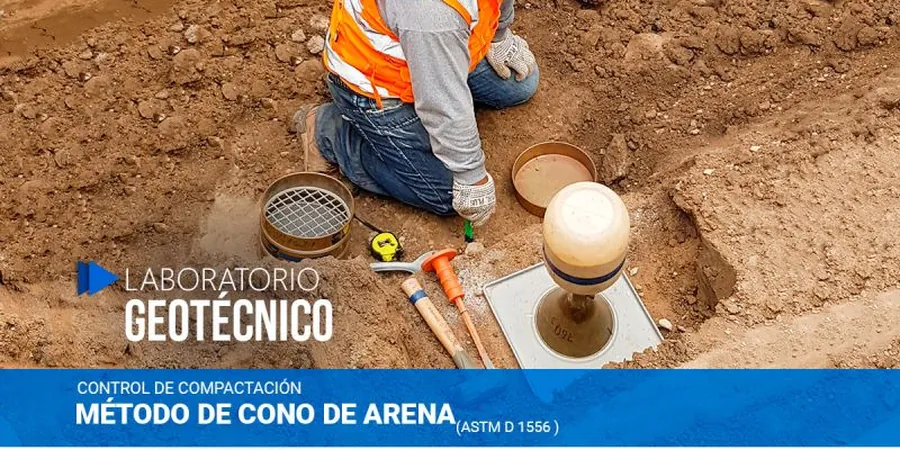
The Franklin District's wet winters rewrite the moisture-density relationship from one week to the next. A clay fill that rolled in at 98 percent standard compaction in March can drop to 92 percent after three days of drizzle, simply because the moisture content drifted outside the acceptable range. The sand cone method captures that drift immediately. We pour calibrated Ottawa sand through the cone plate, excavate the test hole to the full lift thickness, and weigh the removed material on site. Moisture content comes from a speedy moisture tester or a microwave burn-off run in the ute, giving a wet density figure within fifteen minutes. That speed matters when you have six lifts of structural fill to sign off before the concrete pump arrives. Pukekohe's basalt-derived residual soils often carry an optimum moisture content between 16 and 22 percent, and the window between too dry and too wet can be narrower than it looks. For roading subgrade we routinely cross-check with a CBR test on the same compacted surface to confirm bearing capacity alongside density compliance.
Field Density Testing in Pukekohe: Sand Cone Method for Earthwork Verification
Technical reference image — Pukekohe

Local considerations

Pukekohe's subdivision boom from the late 1990s onward pushed earthworks onto land that had been market garden paddocks for eighty years. Old cultivation layers, buried topsoil strips, and poorly documented farm track fill sit under plenty of residential lots, and they don't show up on a desk study. A density gauge reading on a nuclear meter can give a reasonable number over clean fill but gets fooled badly by organic pockets or mixed ash-clay interfaces. The sand cone method has the advantage of physically excavating the test hole, so the operator sees the material profile with their own eyes. If the auger brings up fibrous peat or charcoal-flecked ash at 200 mm, the test gets logged accordingly and the compaction target may need re-evaluation. Skipping field density verification on non-engineered fill in Pukekohe's frost-free but high-rainfall environment risks differential settlement that cracks pavements and pulls services apart within the first five years of occupancy.

Need a geotechnical assessment?

Reply within 24h.

Email: contact@geotechnical-engineering1.co

Technical parameters

ParameterTypical value
Test standardNZS 4402:1988 Test 5.1 (Sand Cone Method)
Calibration sandGraded Ottawa sand, bulk density verified every 20 tests
Test depthFull lift thickness, typically 150–300 mm
Minimum test frequency (earthworks)1 per 500 m² per lift per NZS 4431 guidelines
Minimum test frequency (road subgrade)1 per 200 m² per layer per NZTA M/3 specification
Moisture determinationField moisture balance or microwave drying per NZS 4402 Test 2.1
Reporting metricRelative compaction (%) = field dry density / Proctor maximum dry density

Associated technical services

01

Sand Cone Density Testing

On-site wet density and moisture content determination using the calibrated sand cone apparatus per NZS 4402 Test 5.1, with results delivered as relative compaction referenced to the material-specific Proctor curve.

02

One-Point Proctor Correlation

Rapid laboratory maximum dry density determination on the same material excavated from the density test hole, eliminating the error that comes from using a generic curve on variable Franklin soils.

03

Fill Certification Reports

Compiled test records with GPS-referenced locations, lift-by-lift compaction summaries, and compliance statements formatted for Auckland Council and Waikato District Council engineering approval.

Applicable standards

NZS 4402:1988 Methods of testing soils for civil engineering purposes – Test 5.1 Sand cone method, NZS 4431:1989 Code of practice for earth fill for residential development, NZTA M/3 Specification for road construction and maintenance – Compaction control, NZGS Guidelines for earthworks in residential subdivisions

Frequently asked questions

How much does a sand cone density test cost in Pukekohe?

A single field density test using the sand cone method on a Pukekohe site typically runs between NZ$160 and NZ$260, depending on the number of tests per visit and whether a one-point Proctor correlation from the same material is required. Mobilisation may be additional for small test counts. We quote per-day rates that bring the unit cost down when testing multiple lifts on the same day.

How many density tests does the council require for a residential subdivision fill?

NZS 4431 recommends a minimum of one test per 500 square metres per compacted lift for general earthworks, and NZTA M/3 calls for one per 200 square metres on road subgrade. The actual frequency on a Pukekohe subdivision gets set in the earthworks specification approved by council, and we always recommend confirming the required test schedule with the project geotechnical engineer before starting.

Can the sand cone method be used on coarse gravel or scoria fill?

The sand cone method works best on soils with a maximum particle size under about 37.5 mm. For coarse Pukekohe scoria or quarry-run basalt fill with larger stones, we often recommend a water replacement test or a larger-volume test pit density determination. The technical team assesses the material grading during the first visit and selects the appropriate method to avoid biased results from oversize particles displacing the calibration sand.

Location and service area

We serve projects across Pukekohe and its metropolitan area.

View larger map