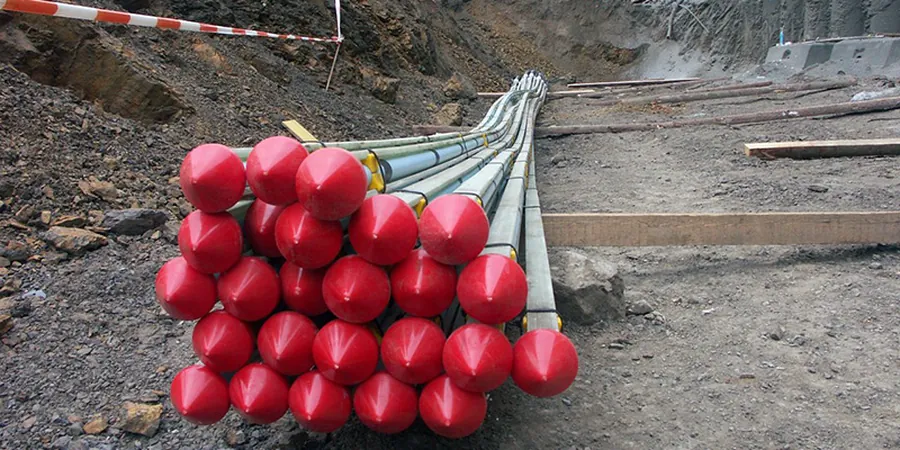
Too many projects in Pukekohe start with the assumption that a standard retaining wall will hold, only to find tension cracks opening up behind the wall six months later. The volcanic soils here—derived from the basalt flows of the Franklin Volcanic Field—look competent in a test pit but can weather into clayey silts with low shear strength. That combination catches out designers who do not account for the actual lateral earth pressures on-site. An active anchor system pre-loads the ground and controls movement from day one, while passive anchors are better suited for temporary cuts or rock conditions where deformation is acceptable. Before committing to a foundation scheme, we often recommend a test pit investigation to confirm the soil profile, especially where the contact between weathered basalt and underlying Waitemata Group sediments is irregular.
In Pukekohe's residual volcanic clays, anchor capacity often drops by 30% if the bond zone stays saturated during winter—drainage detail matters as much as the steel grade.
Local considerations
Anchor performance in Pukekohe varies starkly between the well-drained volcanic slopes east of the railway line and the lower-lying peaty ground west toward the Waikato River floodplain. On the eastern side, residual clays provide decent bond once you get below the root zone, and active anchors are predictable—our proof tests generally show less than 2 mm of creep over the 60-minute hold. West of town, organic silts and peats can extend to five metres depth, and passive anchors installed without pre-grouting tend to creep under sustained load. The bigger risk is ignoring the seasonal water table shift: anchors designed with a bond length in dry summer conditions can lose capacity when winter groundwater rises into the fixed anchor zone, reducing effective stress and side shear.
Frequently asked questions
What is the cost range for anchor design on a typical Pukekohe retaining wall project?
For a standard residential or light commercial retaining wall requiring anchor design, investigation, and proof testing, budgets typically run between NZ$1,910 and NZ$5,390. The final figure depends on the number of anchors, access conditions, and whether permanent corrosion protection is mandated by the soil aggressivity assessment.
How do you decide between active and passive anchors for a Pukekohe site?
The decision hinges on allowable movement. Active anchors are stressed to a lock-off load, immediately compressing the ground and limiting deformation—essential when supporting structures close to the wall. Passive anchors resist only after ground movement occurs, so they suit temporary works or rock cuts where some relaxation is acceptable.
Does the volcanic soil in Pukekohe affect anchor corrosion protection?
Yes, significantly. The weathered basalt profiles often have pH values below 5.5 and moderate electrical resistivity, creating conditions that accelerate steel corrosion. We specify double corrosion protection (DCP) for any permanent anchor in these soils, with corrugated sheathing and factory-grouted encapsulation over the full free and bond lengths.
What proof testing do you perform after anchor installation?
We follow NZGS guidelines: each anchor undergoes a proof test to at least 1.25 times the working load for temporary anchors and 1.5 times for permanent ones. The load is held for 60 minutes while we monitor creep—in Pukekohe's residual clays, we expect creep rates below 2 mm per log cycle of time if the bond length is adequate.
Can you design anchors for earthquake loads under the NZ Building Code?
Yes, all our designs account for seismic demand per NZS 1170.5. In Pukekohe, the seismic hazard is moderate but the soil profile can amplify ground motion through the soft volcanic ash layers. We calculate the increased lateral earth pressure under the design earthquake and size the anchor free length to remain elastic through the seismic event.