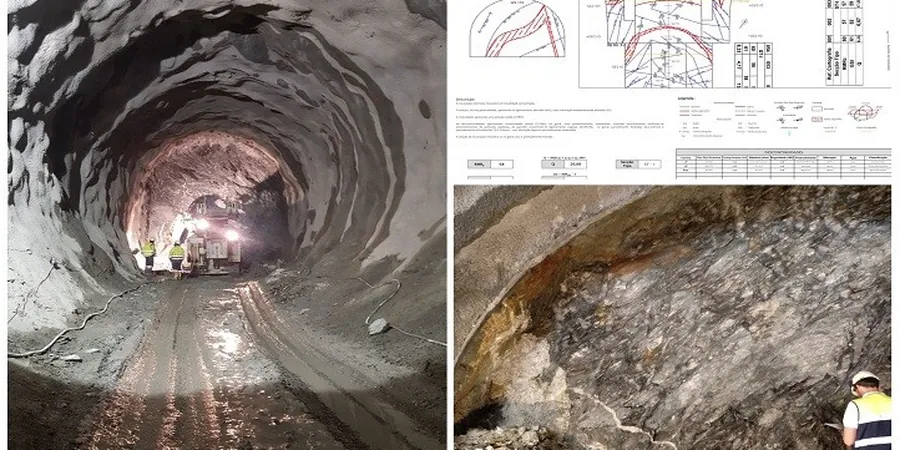
A contractor in Pukekohe once assumed uniform clay and hit a buried peat lens 4 metres down. The TBM lost face pressure and the crown settled 80 mm overnight. Recovery cost six weeks and a full redesign of the support sequence. Soft-ground tunnelling through the weathered Puketoka Formation and overlying alluvium that underlies much of Pukekohe demands more than a desktop study. It requires targeted CPT testing to map transitions between firm silt and compressible organic layers, and a laboratory program that measures stiffness degradation under undrained loading. Our team supports projects across Pukekohe with site investigation, constitutive model calibration, and real-time monitoring during excavation.
A tunnel in Pukekohe's mixed soft ground is not a single-design problem. It is a sequence of transitions that must be analysed metre by metre.
Local considerations
A shallow drainage tunnel on Pukekohe's eastern edge encountered a water-charged sand lens within the alluvium in 2021. The face became unstable within minutes of hand-mining, and the resulting cavity propagated upwards through weathered tuff until it daylighted in a paddock. No one was injured, but the event shut down operations for three weeks. In soft soil tunnelling, the primary hazard is not just low strength but high spatial variability. A peat pocket or a thin pumiceous layer can concentrate groundwater flow and trigger localised collapse. We mitigate this with systematic pre-excavation probing, pore pressure monitoring, and staged permeability testing using in-situ falling-head methods. Numerical models are updated daily as new face logs come in, keeping the support class matched to actual ground behaviour.
Frequently asked questions
What ground conditions make soft soil tunnelling difficult in Pukekohe?
The main challenge is the interlayering of weathered Puketoka volcanic soils with compressible alluvium and occasional peat lenses. These units have very different stiffness and permeability values, which creates uneven loading on linings and requires frequent face support adjustments.
Which laboratory tests are essential for tunnel design in soft ground?
Consolidated-undrained triaxial tests provide the undrained shear strength for stability calculations. Oedometer tests define the consolidation parameters for settlement prediction. Atterberg limits and particle size distribution complete the classification needed for NZGS-conformant logging.
How do you handle groundwater during tunnel investigations in Pukekohe?
We install standpipe and vibrating-wire piezometers in separate boreholes to measure static and construction-induced pore pressures. In-situ falling-head tests give us the permeability range needed to design dewatering or face drainage systems.
What is the typical cost range for a tunnel geotechnical analysis in Pukekohe?
A full geotechnical analysis for a soft soil tunnel project in Pukekohe typically ranges between NZ$6,520 and NZ$24,190, depending on the length of the alignment, the number of boreholes and CPTs required, and the complexity of the laboratory testing programme.
Can you update the ground model if conditions change during excavation?
Yes. We provide construction-phase support where face logs, convergence data, and piezometer readings are fed back into the numerical model daily. This allows us to recommend support class changes before instability develops at the face.