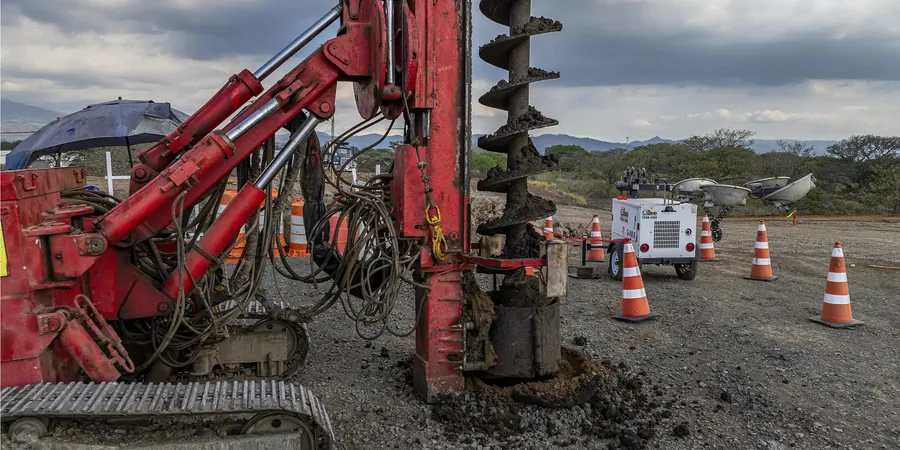
The volcanic landscape around Pukekohe, with its deep weathering profiles of basalt and interbedded tephra layers, creates a geotechnical setting where differential settlement becomes a real headache for any mid-rise or industrial development. The Pukekohe basalt clays can soften dramatically after heavy winter rain, and the loose pumiceous silts found at depth across the Franklin district are notoriously compressible. Because the local horticultural boom has pushed construction onto former market garden plots with variable fill, developers in Pukekohe need a ground improvement strategy that works with the native soil rather than simply excavating it. Stone column design offers a cost-effective path to strengthen these deposits by installing compacted gravel columns that densify the surrounding ground while providing vertical drainage. Before committing to a deep foundation, many projects benefit from a preliminary SPT drilling campaign to map the thickness of the weathered horizon, or a CPT test to capture continuous tip resistance and friction ratios through the interbedded ash layers.
Stone columns in Pukekohe volcanic soils do double duty: they strengthen the ground for bearing and slash the time needed to drain earthquake-induced pore pressures.
Methodology and scope
Our approach to stone column design in Pukekohe follows the NZGS Module 4 guidelines for ground improvement, adapting the Priebe method (Heinz J. Priebe, 1995) for replacement ratio and settlement estimation to local soil parameters. We typically specify a column diameter between 600 mm and 900 mm, installed by bottom-feed vibrator to avoid collapse in the soft alluvium found near the Pukekohe Hill escarpment. The design process involves calculating the improvement factor (n) from the area replacement ratio and the constrained modulus of both the column material and the matrix soil, then checking bearing capacity against the factored structural loads from NZS 3404. For sites where the Pukekohe volcanic ash extends deeper than 8 metres, we often integrate
seismic microzonation data to refine column spacing under combined static and seismic conditions, ensuring the treatment zone extends through the full liquefiable depth as defined by the NZGS-MBIE liquefaction module. A rigorous quality control programme accompanies every installation, including
in-situ permeability testing to verify that the stone columns are indeed functioning as effective drainage paths, reducing the time to dissipate excess pore pressure after a seismic event.
Local considerations
Pukekohe's expansion over the last two decades has pushed subdivision boundaries into areas underlain by the Puketoka Formation, where loose Holocene sands and silts are fully saturated and susceptible to liquefaction during a Waikato fault event. The 2001 NZGS reconnaissance after the Edgecumbe earthquake highlighted how quickly volcanic-derived soils can lose their structure, and Pukekohe's shallow groundwater table, often sitting just 2 metres below the surface in the lowlands near the Tutaenui Stream, amplifies that risk. Skipping a proper ground treatment design in these zones can leave a warehouse slab with post-earthquake undulations exceeding 150 mm, enough to snap racking systems and halt operations for months. Stone column design addresses this head-on by densifying the granular matrix and installing vertical drains that shorten the liquefaction-induced settlement window from days to hours. We model the post-treatment performance using SPT-based liquefaction triggering procedures from Idriss & Boulanger (2014), calibrated to the NZGS-MBIE framework, so the client receives a clear target residual settlement figure before construction begins.
Frequently asked questions
What ground conditions in Pukekohe are most suitable for stone columns?
Cohesionless soils with fines content below 15% respond best to densification, but the vibro-replacement technique is also effective in Pukekohe's silty volcanic clays with undrained shear strength between 15 and 50 kPa. We always run a grain size analysis and Atterberg limits first to confirm the fines fraction and plasticity index before finalising the column grid.
How does the high rainfall in Pukekohe affect stone column installation?
The winter water table rise in Pukekohe can saturate the upper ash layers, so we schedule installation during drier months where possible, or pre-load the platform with a working mat. The stone columns themselves act as vertical drains, which actually helps stabilise the site faster after heavy rain events.
What is the typical cost range for stone column design in Pukekohe?
For a standard commercial or industrial lot in Pukekohe, the design and testing package generally falls between NZ$2,480 and NZ$8,530, depending on the number of CPTs required, the column grid density, and the extent of post-treatment verification testing.