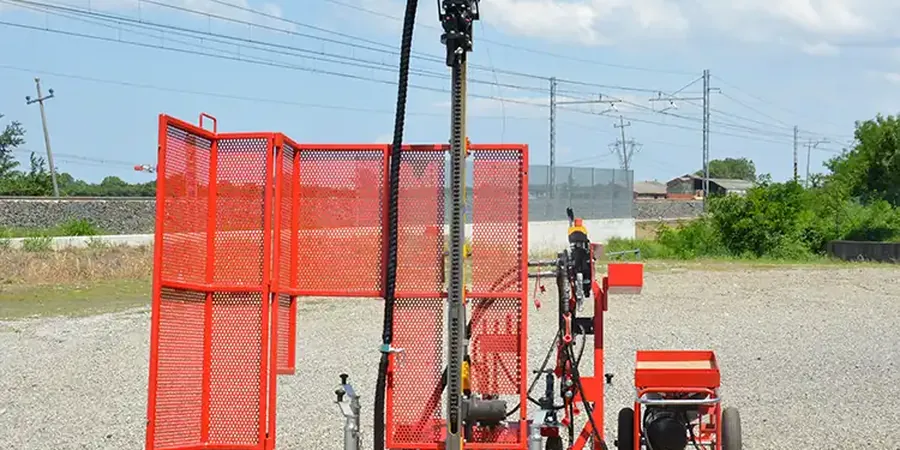
The truck-mounted rig arrives on site with a 63.5 kg hammer that lifts and drops 760 mm, driving a split-spoon sampler 450 mm into the ground. That is the Standard Penetration Test at its core. In Pukekohe, where the landscape shifts from the weathered basalt of the Bombay Hills to the softer alluvial flats around the Whangapouri Stream, we run the SPT to get something every geotechnical engineer needs: a direct blow count that correlates to real soil density. The NZGS guidelines we follow require precise energy calibration of the hammer. Our equipment is set to deliver 60% of the theoretical free-fall energy, which we confirm with rod monitoring before each borehole. For deeper investigations in the volcanic ash layers common across Franklin County, we often pair the SPT with a CPT test to capture continuous pore pressure data, or a seismic refraction survey when the client needs a VS30 profile for site class determination under NZS 1170.5.
A single N-value from the SPT is not just a number; it is a direct window into 450 mm of soil that tells us density, consistency, and load-bearing potential in Pukekohe's layered volcanic deposits.
Local considerations
The stretch of land between Pukekohe East and the valley floor near Buckland illustrates the risk of skipping site-specific SPT data. Pukekohe East sits higher, with residual clays weathered from basalt that typically deliver N-values above 20—competent enough for a conventional strip footing if the bearing capacity checks out. Buckland, closer to the Waikato River tributaries, sits on recent alluvium. We have logged boreholes there where the SPT hammer sank under its own weight in the upper two metres. That is a zero-blow condition, classic soft clay or loose silt, and it demands a completely different foundation solution. Without the N-values, a designer might assume uniform soil across the site. The result could be differential settlement between building modules, cracking in slabs, or worse. The NZGS field guide on soil description and the SPT procedure exists precisely to prevent that assumption. We follow it rigorously, recording groundwater strike depth and any drilling fluid loss, because in this part of Franklin County the water table can be perched within the ash layers and create additional liquefaction concerns under seismic load.
Frequently asked questions
How much does an SPT borehole cost in Pukekohe?
For a standard SPT borehole in Pukekohe drilled to 15 metres depth with N-value measurements every 1.5 metres and a full soil log per NZGS guidelines, the cost ranges from NZ$970 to NZ$1,440 plus GST. The final figure depends on access conditions, the presence of basalt floaters that slow drilling, and the distance from our Franklin County depot.
How is the SPT N-value corrected for New Zealand conditions?
We apply corrections for hammer energy ratio (CE), rod length (CR), borehole diameter (CB), and sampler type (CS) following the standard N60 correction method. For Pukekohe sites, we also evaluate overburden correction (N1)60 when the data feeds into liquefaction triggering analyses per NZGS 2021 guidelines, which account for the region's shallow water table in the alluvial areas.
How deep do you drill SPT boreholes in Pukekohe?
Typical depth for a residential investigation in Pukekohe is 15 to 20 metres. We need to penetrate the weathered volcanic ash and basalt-derived clays to reach either competent rock or a depth where the stress influence from the proposed foundation becomes negligible. For commercial buildings with deeper load influence, we may drill to 30 metres or refusal.
Can the SPT detect the volcanic ash layers common around Pukekohe?
Yes, the SPT can identify the ash layers. The sampler recovers the material, and we log the colour, grain size, and consistency on site. The Pukekohe ash, part of the Auckland Volcanic Field deposits, typically appears as a fine sandy silt with distinct brown to orange mottling. The N-values in these layers often drop noticeably compared to the overlying and underlying residual clays, which alerts the engineer to a potential weak horizon.
How long does an SPT investigation take in Pukekohe?
A single 15-metre borehole in typical Franklin County soils takes about four to five hours of drilling time. We can usually complete a standard three-borehole subdivision investigation in one to two days on site, with the final geotechnical report delivered within seven working days after the fieldwork is completed.