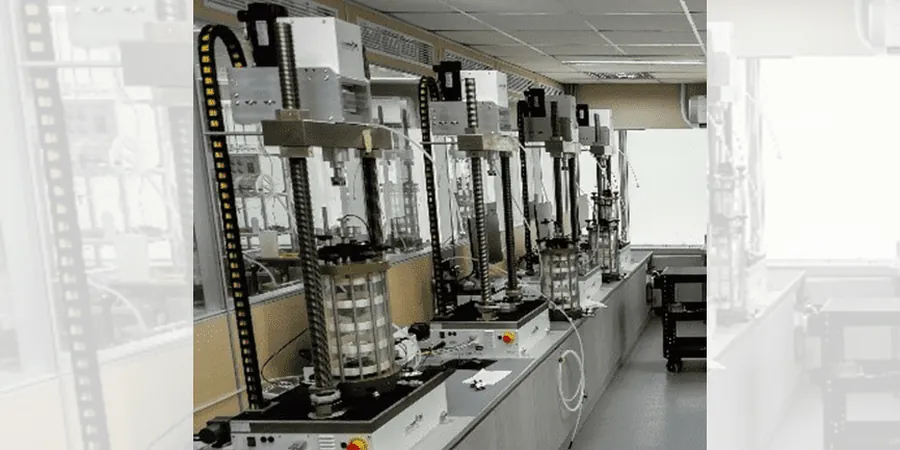
A common mistake we see in Pukekohe is assuming the compacted volcanic ash has the same undrained strength as the weathered basalt underneath it. The soft, silty clay of the Puketoka Formation crushes under deviatoric stress in ways a simple pocket penetrometer won't catch. When footings go in without consolidated-undrained triaxial data, differential settlement shows up within two wet seasons. Our team runs consolidated-undrained (CU) and unconsolidated-undrained (UU) triaxial programs on Shelby tube samples extracted right from the construction depth, delivering effective friction angles and cohesion intercepts that hold up against the region's fluctuating groundwater table.
A 15-degree difference between peak and critical-state friction angle changes the required footing width by over 400 mm in saturated Puketoka ash.
Methodology and scope
The volcanic parent material across Pukekohe presents a tricky contrast: well-drained granular horizons at the surface shift abruptly into moisture-sensitive cohesive layers below. When saturation exceeds 85%, the effective stress path bends toward failure much earlier than dry-season data would suggest. We run three-stage CU triaxial tests with pore pressure measurement per NZS 4402:1986, applying confining pressures that bracket the in-situ overburden. Back-pressure saturation ensures B-values above 0.95 before shear, which matters because air voids in the ash matrix can mask true pore pressure response.
The equipment in our laboratory includes 100 kN load frames with submersible transducers, capable of strain rates from 0.001 to 5 mm/min. For projects near the Pukekohe volcanic cone where fill thickness varies wildly, we pair the triaxial program with index testing to track plasticity changes across the profile. The output isn't just a peak strength envelope; we also isolate the critical state friction angle for situations where large strain conditions govern, such as embankment loading on compressible ground.
Local considerations
Pukekohe's expansion southward from the old railway corridor has pushed subdivisions into terrain where the Puketoka Formation pinches out against weathered basalt. The risk here is not just low shear strength — it's strength anisotropy. Remnant jointing in the basalt saprolite can produce a 30% drop in undrained strength when samples are sheared parallel to relic fabric. Without careful sample orientation during triaxial setup, the laboratory c_u overestimates the in-situ resistance, and that gap only becomes visible after a cut fails. The Franklin District Council's consent process increasingly requires site-specific triaxial data for any excavation deeper than 2.5 m in these transitional zones, especially where fill placement exceeds 500 mm. Our laboratory's QA system, accredited to ISO 17025, ensures each specimen's moisture content and density are tracked against the field log before the piston ever touches the cap.
Frequently asked questions
How much does a triaxial test program cost for a Pukekohe site?
A standard set of three CU triaxial specimens runs between NZ$3,350 and NZ$4,840, depending on sample diameter and whether back-pressure saturation is required. The price includes specimen trimming, consolidation, shear, and the full engineering report with stress path interpretation.
What's the difference between CU and UU triaxial tests?
The CU test consolidates the specimen under a confining pressure before shearing it slowly, allowing pore water to drain during consolidation but not during shear, with pore pressure measured continuously. This gives effective stress parameters (c' and φ'). The UU test applies no consolidation, shears quickly, and measures total stress undrained strength (c_u). For Pukekohe's saturated ash layers, CU results are more representative of long-term stability because they capture how excess pore pressure reduces effective friction.
How many triaxial specimens do I need for a residential foundation in Pukekohe?
For a single residential lot on the Puketoka Formation, we recommend a minimum of three CU specimens taken from the bearing stratum depth plus one UU from the overlying desiccated crust if it exceeds 400 mm thickness. If the site straddles two geological units — say weathered basalt and volcanic ash — you need three specimens per unit to define separate failure envelopes. The Franklin District consent documentation will typically ask for at least one test per 1.5 m of bearing stratum.