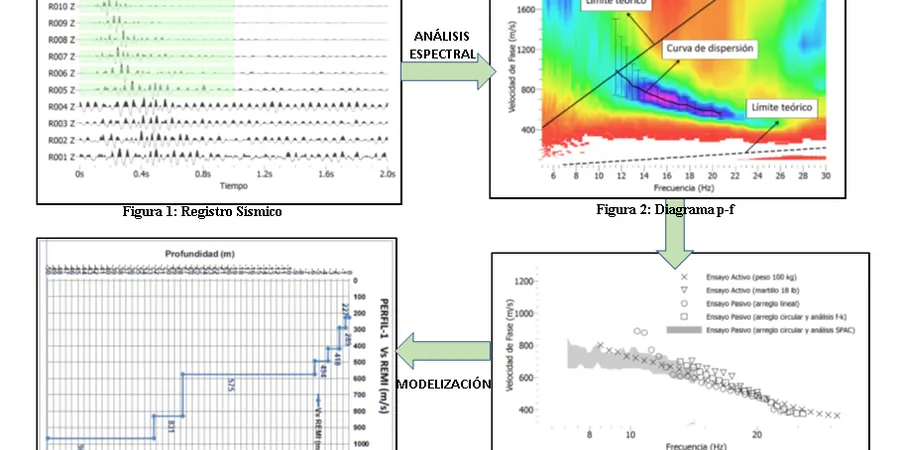
We roll out the 24-channel seismograph across a paddock off Pukekohe East Road, laying a string of 4.5 Hz geophones at two-metre spacing. The sledgehammer hits the aluminium plate, the signal races through the weathered basalt and Tauranga Group sediments, and the laptop starts building a dispersion curve. That curve tells us more about the top 30 metres than a dozen borehole logs ever could. In the Franklin District, where volcanic residuals sit right next to soft Pukekohe Hill alluvium, the shear wave velocity changes fast. A competent-looking clay pan at one metre can mask a low-velocity pocket at eight metres. The seismic refraction profile often flags the same interface, but MASW gives us the actual stiffness numbers for the ground model. When the structural engineer asks for Site Class, we have the Vs30 figure backed by direct measurement, not just correlation tables.
A Vs30 value measured across Pukekohe's volcanic-ash interface is rarely the same as the one interpolated from a regional map.
Local considerations
Across the railway line, the ground changes character completely. Sites west of the station, closer to the basalt outcrops, often deliver Vs30 values above 400 m/s, comfortably Class C. Move east into the flats around Pukekohe East, and the same 24-channel spread picks up Vs30 under 200 m/s, putting the site squarely in Class D. The risk is that a structural design based on a desktop study assumes uniform conditions. We have seen two adjacent lots on Seddon Street return different site classes because one sits on a buried volcanic ridge and the other on basin fill. Getting the site class wrong has real consequences: underestimated seismic loads if you assume rock, or an overly stiff structure if you design for soft soil that is not actually there. The liquefaction potential ties directly to the Vs profile too — once we have the shear wave velocities layer by layer, the trigger analysis is straightforward.
Frequently asked questions
What does a MASW survey in Pukekohe cost?
For a standard single-line MASW survey with Vs30 reporting, our fees in the Pukekohe area range from NZ$2,810 to NZ$4,720 depending on access conditions, array length, and whether passive-source data is required for deeper profiling.
How long does the field work take, and how much space is needed?
A typical active-source MASW spread runs 46 to 50 metres in length and takes about an hour to lay out, shoot, and pack up. We need a relatively straight, flat line free of buried services. The sledgehammer source is non-invasive and leaves no disturbance, so the setup works on lawns, paddocks, or prepared building platforms.
Can MASW replace boreholes for site classification?
MASW gives you the in-situ stiffness profile directly, which is exactly what NZS 1170.5 needs for Site Class. However, it does not provide soil samples for visual classification or laboratory testing. In Pukekohe we often combine MASW with a test pit or SPT borehole so you have both the dynamic properties and the physical description of the strata — the two datasets together make a much stronger consent submission than either alone.